How to Pack Fragile Items for Moving
Fragile items like glassware, mirrors, artwork, and electronics should be packed with extra protection using bubble wrap, packing paper, sturdy boxes, and labeled “Fragile”. This helps in preventing damage to precious and often expensive items during transit.
Key Takeaways
- Relocating with fragile items like mirrors and antiques requires careful planning.
- Use sturdy, high-quality boxes, wrap each item individually, use cushioning materials, fill empty spaces, and label boxes.
- Get help from professional movers to minimize risk of damage.
Moving fragile items from one place to another is a challenge. According to a report by the US Moving Protection, over one-third of all customer complaints are due to damaged goods during a move.
Steer clear of this statistic. Read on to know how to pack fragile items for secure transportation across distances.
What Supplies Do You Need for Packing Fragile Items?
Use the right supplies for packing fragile items to prevent damage, breakage, and financial loss in transit or storage, such as bubble wrap, packing peanuts, foam etc.
High-quality packaging materials provide cushioning, absorb shocks from drops or vibrations, and immobilize items to stop them from shifting.
| Material | Best For | How it Helps |
| Bubble Wrap/mushroom packaging/honeycomb paper | Glass, ceramics, electronics | Shock absorption |
| Packing Paper | Dishes, collectibles | Prevents scratches |
| Foam Peanuts | Filling empty spaces | Prevents shifting |
| Dish Packs | China, glassware | Extra durability |
| Corner Protectors | Mirrors, artwork | Prevents edge damage |
| Packing Tape | Sealing boxes | Keeps boxes secure |
Table 1: Recommended Packing Materials
General Guidelines for Packing Fragile Items for Moving
Here’s a detailed guide on how to pack fragile items during a move:
Step 1 – Prepare Your Packing Area
Start by clearing out a space to make it the designated packing area. Lay out the fragile items carefully, so they do not bump into one another, and you can easily access each item.
This will speed up the packing process and eliminate chances of damage to the items.
Step 2 – Wrap Each Item Individually
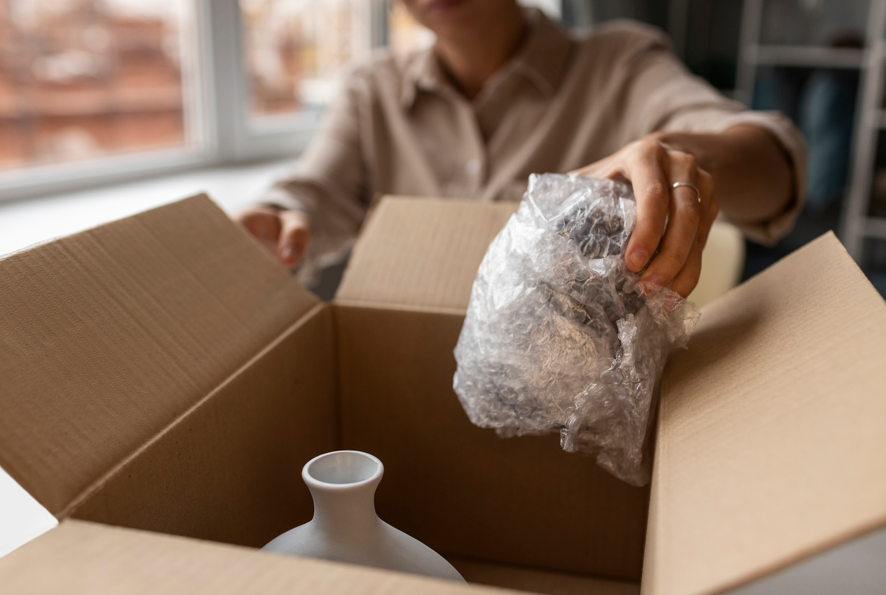
Carefully wrap each item with 2-3 inches of bubble wrap and packing paper. Opt for large bubble wrap for maximum cushioning, and anti-static bubble wrap for electronics.
The right wrapping material and technique prevent scratches, absorb shocks, and reduce the scope of breakage in case the drive becomes bumpy.
Note: For wrapping irregular or uneven items, use the ‘Taco Method’ for double protection. Put the item right in the middle of the packaging paper and fold the paper over.
Step 3 – Cushion the Box Properly
Start by ensuring there is generous cushioning before you proceed to put each item.
- First, layer the bottom of the box with bubble wrap.
- Then, put the carefully-packed items inside the box.
- Lastly, fill in the remaining gaps with extra padding, aka more bubble wrap.
This method keeps the items from shifting during the ride. This is why we at American Van Lines suggest the same technique for cushioning a box holding fragile items.
Step 4 – Seal and Label Boxes
Lastly, secure each box with strong tape and label each box carefully. Use the H-taping method to ensure the seal is strong and won’t open or loosen in transit. Here’s how you H-tape:
- Apply the packing tape down the length of the bottom flap of the box. Press down firmly with your thumb to remove air pockets.
- Repeat the process across the two sides of the bottom flap. Once done, the tape formation should look like an H.
- Turn the box upright and repeat steps 1 & 2 on the top flaps.
Stick ‘Fragile, handle with care’ labels on all sides. Additionally, write what each box contains.
Pro tip: Secure the bottom of the box before you put the items in. Keep appropriate lengths of tape cut out from the roll to speed up the process.
See also: 7 Surprising Ways Furnaces Affect Home Comfort Beyond Heat
Packing Checklist For Fragile Items
Here’s a comprehensive checklist for packing fragile items before moving:
| Step | Task | Done |
| 1. Gather the Right Packing Materials | Double-walled boxes, bubble wraps, packing peanuts | ✅ |
| 2. Clean & Prepare Items Before Packing | Clean, dust, and disassemble each item | ✅ |
| 3. Wrap Each Item Individually | Wrap fragile items separately using bubble wrap and packing paper | ✅ |
| 4. Use the Right Packing Technique | Place heavier items at the bottom, fragile ones on top of the box, and fill spaces with padding | ✅ |
| 5. Add Cushioning & Protection | Add padding at the bottom of boxes and cushioning between each layer | ✅ |
| 6. Label Everything Clearly | Mark boxes as “FRAGILE” and use color coding for easy identification | ✅ |
| 7. Document High-Value Items | Maintain a list of valuable items and take photos before packing | ✅ |
| 8. Prepare for Transport | Load fragile items last and avoid stacking anything on top of them | ✅ |
| 9. Special Care for High-Risk Items | Use special packaging and original boxes for electronics, artwork, and fragile items | ✅ |
Table 2: Comprehensive Packing Checklist
How to Pack Fragile Items: Guidelines for Different Products
Given below are separate guidelines for packing different fragile items for moving.
China and Glassware
Here’s how to pack china and glassware, such as cutlery, drinkware, antique showpieces, and so on:
- Wrap each plate and glass individually with packing paper or bubble wrap
- Stack plates vertically and not flat
- Use dish pack boxes and stemware boxes for added protection
- Avoid leaving space in boxes
- Add padding or cushioning between layers
- Use a newspaper to avoid ink stains
Mirrors
To prevent mirrors from breaking during the move:
- Pick a box that is as close as possible to the mirror in dimension
- Clean the mirror thoroughly before packing; any debris can cause scratches in such close quarters
- Use painter’s tape in an “X” pattern across the glass (holds pieces together in case of breakage)
- Wrap with bubble wrap/glassine paper and cardboard
- Use mirror boxes or telescoping boxes
- Protect corners with guards
- Label the mirror’s box after packaging (Fragile: Mirror, and This Side Up stickers)
Artwork
To prevent sensitive and costly artwork from getting damaged during the move:
- Cover artwork with glassine or acid-free paper
- Wrap frames separately
- Use custom crates for valuable pieces
- Avoid direct contact with bubble wrap on painted surfaces
Records
Avoid warping, cracking, or surface scratches on the vinyl records during the move by:
- Packing vinyl records vertically and never flat
- Using sturdy, snug boxes
- Keeping them away from heat and humidity
- Adding cardboard dividers for protection
Lamps
To protect unique and fragile lamps while moving:
- Remove bulbs, shades, and harp
- Wrap the base separately
- Pack lampshades in their own box
- Use soft materials to avoid dents
Electronics
Prevent damage and potential malfunction in expensive electronic items by:
- Putting them in their original packaging, if available
- Wrapping the electronic devices in anti-static bubble wrap
- Placing the gadgets in boxes cushioned well with foam peanuts
- Using soft materials to prevent dents or scratches
Pro tip: Refer to the DOT’s guidelines for packing all devices with non-removable lithium batteries.
Musical Instruments
Avoid structural and functional damage in musical instruments by:
- Loosening the strings of string instruments to reduce tension and neck damage, or disassembling pieces and wrapping each part separately, in the case of woodwinds or brass
- Wrapping instruments individually in soft cloth and anti-static bubble wrap
- Using a hard-shell case
- Filling empty gaps (if any) inside the case with bubble wrap or soft cloths to prevent shifts
- Placing the hardcase inside a slightly larger, sturdy cardboard box and filling gaps with bubble wrap or packing peanuts
Pro tip: Opt for acid-free paper over newspaper and the vertical packing technique (side-by-side stacking, like dishes in the drying rack) and other specialized packing techniques to prevent damage to string instruments.
Common Mistakes to Avoid When Packing Fragile Items
Here are some common errors to avoid:
1. Using Weak or Low-Quality Boxes
Issue: Thin or reused boxes can collapse under weight, lacking structural strength.
Fix: Use sturdy, double-walled boxes for all fragile items like artwork, glassware, electronics, or mirrors.
2. Skipping Proper Cushioning
Issue: Minimal padding means direct impact and a greater chance of items hitting each other inside the box.
Fix: Use sufficient bubble wrap, packing paper, foam, or packing peanuts to ensure appropriate cushioning.
3. Not Wrapping Items Individually
Issue: Items like plates, glass, decor, or artwork scratch or break when they come in contact with one another.
Fix: Wrap each item individually before placing it in the box.
4. Overpacking or Underpacking Boxes
Issue: Overpacking puts excess pressure on items, leading them to crack, whereas underpacking leaves spaces for items to shift and collide.
Fix: Fill empty spaces while maintaining a balance between overpacking and underpacking. This will stop items from shifting and colliding.
5. Not Labeling Boxes as “Fragile”
Issue: Movers might mix fragile boxes with regular ones and handle them without caution, or worse, roughly.
Fix: Label clearly with “Fragile”, “This Side Up”, or additional handling instructions.
6. Placing Fragile Items Incorrectly in Boxes
Issue: Delicate items get crushed or damaged when heavy items are placed on top or when items are stacked flat.
Fix: Place heavier items on the bottom, lighter ones on top, and opt for vertical stacking over flat stacking.
7. Poor Loading During Transport
Issue: When fragile boxes are placed under heavy furniture, every movement during transit causes damage.
Fix: Load fragile items last and keep them in an upright position to secure them. Avoid stacking heavy items above them.
8. Not Using Original Packaging For Electronics
Issue: Generic packing may not offer a proper fit for highly sensitive items like TVs, monitors, and appliances.
Fix: Use original boxes and foam inserts wherever there are empty spaces.
9. Using Too Much or Too Little Tape
Issue: Weak sealing leads to boxes flying open during transit, while excess tape makes unpacking difficult and leads to potential damage.
Fix: Seal boxes firmly using the H-taping method to ensure a proper seal without room for potential damage.
When You Should Hire Professional Movers
Here are a few situations when it is necessary to hire professional movers for packing fragile items:
- Moving high-value or sentimental items
- Moving delicate electronic items
- Transporting large glassware or mirrors
- Lack of experience in moving fragile items
When You May Not Need Professional Movers
The assistance of professional movers might not be necessary for packing and moving all fragile items:
- A small number of fragile items that do not hold much value
- Existing packing expertise in moving fragile items
Note: Before you proceed to pack and move fragile items on your own, make sure you have done your part of research and stocked up on all necessary packing supplies.
Planning To Move Fragile Items? Contact Our Professional Movers Today!
Moving fragile items challenges anyone. However, careful planning and packing make the process easier. Learning correct packing techniques saves money and stress while eliminating breakage.
American Van Lines offers you a foolproof plan with superior service. Get in touch for moving quotes.
Frequently Asked Questions
Should Fragile Items Go on Top or Bottom of Boxes?
Fragile items should be packed on top of boxes, and the empty space above should be filled with packing peanuts or crumpled paper. Label the box as ‘FRAGILE’. This helps in ensuring maximum safety and lowering the chances of damage.
How Do Movers Protect Delicate Items During Transport?
Delicate items demand special transportation. This is why we use high-quality packing materials like bubble wrap and foam peanuts for individual packaging and filling gaps.
Is It Necessary to Disassemble Fragile Furniture or Decor Pieces Before Packing?
Yes, absolutely. Disassembling fragile furniture or other items is a must before packing. Breaking items down into smaller and individual components lowers the risk of damage and helps with better protective wrapping.
Is Double Boxing a Good Plan for Fragile Items?
Double boxing is an excellent and highly recommended strategy. This makes it easy to overcome moving and packing challenges caused by external impacts, vibrations, and crushing forces during transit.
How Much Does a Professional Packing Service Cost?
The charges of professional packers vary. For instance, we at American Van Lines charge for our services depending on the number of items, packing needs, and other things. Get in touch with our team to know about our pricing.